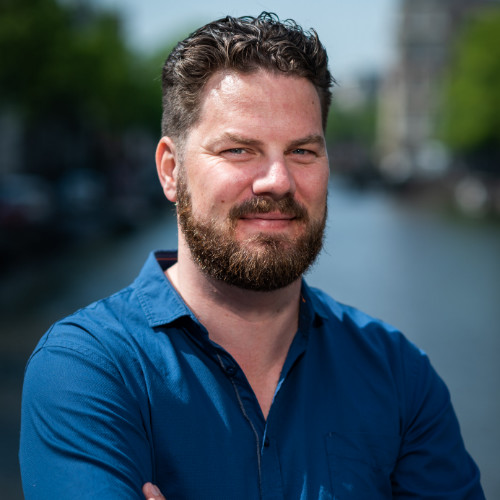
Meet the Expert - Sascha Selzer: From military software engineer to senior Java consultant
How a former Airbus engineer found his calling in consulting, training, and making software visible.
Series introduction: In this “Meet the Experts” blog series, developers from OpenValue share who they are, what drives them, and what makes working at OpenValue different. In this edition we meet Sascha Selzer, a senior Java consultant, certified iSAQB trainer, and conference speaker at OpenValue Düsseldorf. His path into consulting started with a broken log file and soldiers looking over his shoulder.
The log file that started it all
Before joining OpenValue, Sascha worked for 12 years at Airbus in Germany. Not in a cockpit, but in the code. He started through Germany’s duales Studium, a dual education system where a company employs you, pays your tuition, and you alternate between studying and working. By the time he graduated with a Bachelor of Science, he was already a working software engineer.
His first role however wasn’t writing code. It was deploying it. As an infield engineer, he travelled to military exercise sites to install and operate air-gapped software systems for the German army. No cloud, no remote debugging, no Stack Overflow. Just you, a machine, and a customer watching over your shoulder.
It was during one of those field deployments that something fundamental clicked. When the software broke, the first thing he reached for was the log files. And what he found shaped the rest of his career.
“The log said something like ’this shouldn’t happen.’ That was the entire diagnostic information. Meanwhile, someone from the army is sitting next to you asking what the issue is.”
That moment planted a seed in his brain that Sascha carries with him to this very day: how software operates matters just as much as how it’s built.
“I would have been incredibly grateful in those early field deployments to have anything more than just log files. That experience never left me.”
Why consulting and why Sascha chose OpenValue
At Airbus, Sascha progressed from junior developer to software architect. He had a network, a reputation, and nice comfort zone. But two former colleagues who left for consumer-facing companies opened a window to a different world. Millions of users, direct feedback loops, visible impact.
The contrast with his military work couldn’t be bigger. “You rarely get direct feedback on whether your work made a difference. There are always layers of contract managers in between.” He wanted to build things people actually use in their daily lifes. That led him to consulting at INNOQ, and eventually to OpenValue.
Sascha wasn’t looking for a new role when OpenValue appeared on his radar. A recruiter described the company to him as: continuous learning, knowledge sharing and autonomy in your role. The same values he appreciated at INNOQ, but with something extra. A promise of regular, in-person connections with his OpenValue colleagues. After years of post-COVID remote isolation and working from his home office, that mattered a lot for him.
The interview process was characteristically OpenValue. Gerrit de Boer, Director of OpenValue Düsseldorf, suggested meeting at JCON, a big Java conference in Germany. He offered Sascha a ticket and they decided to perform the “interview” in a coffee corner at JCON. “It wasn’t complicated in any way. He just said: if we want to meet, let’s just do it here. The conversation just matched. I knew immediately: this will work.”
A technical conversation with CTO Bert Jan Schrijver confirmed the match. They shared the same wavelength on software development principles and the same belief in building solid foundations over chasing hype.
The right company size and passionate colleagues
When Sascha joined, the Düsseldorf team was twelve people. Coming from Airbus (100,000+ employees worldwide) via INNOQ (around 160), he’d been scaling down consistently. And loving every step of it.
“At Airbus, I worked with great engineers and received support for my ideas, but it is more complicated to realize these ideas and make an impact as an individual due to processes, regulations, the organizational structure and the sheer size of the company and the contracts. At OpenValue, that mindset simply doesn’t work. And I wouldn’t want it to.”
What struck him most was how naturally colleagues share their knowledge and experiences. Not because they’re told to, but because they genuinely want to. Brown bag lunch sessions, Thursday project chats, and most importantly: the informal coffee corner conversations at the OpenValue office location. Someone mentions a niche tool they discovered, a workflow they improved, or a pattern they’re questioning. That’s where the real learning happens, according to Sascha.
“The vibe is like meeting good friends, not just colleagues. There are strong technical opinions and real debates. But it always feels open, friendly, and safe.”
Thursday is office day in Düsseldorf. What starts with project updates flows into shared lunches, technical deep-dives, and the kind of spontaneous conversations that remote work can’t replicate. The office is getting a bit crowded as the team grows. Sascha doesn’t mind. “I like hearing discussions from other people about topics where I can jump in or jump out.”
That culture of knowledge sharing is what makes OpenValue more than a consultancy, according to Sascha. It’s a group of people who believe that getting better at software development is a team sport.
Standing on the shoulders of colleagues
When asked about inspiration within OpenValue, Sascha names several colleagues. Each for different reasons.
Alexei Bratuhin is working as as senior developer at OpenValue Düsseldorf. He stands out for his desire to really understand things from the ground up. “With AI, for example, Alexei doesn’t just want to know how prompting works. He wants to understand the components that are under the hood. How you’d build something from scratch to truly grasp how it works.Alexei is also one of the most active brown bag presenters, turning his deep-dives into short, accessible knowledge shares. I really like that about him and it inspires me to keep pushing myself as well.”
Younger colleagues like Lukas Poos and Jens Knipper inspire him in a different way. Jens has become one of OpenValue Düsseldorf’s software development conference speakers. What impresses Sascha most is the depth behind the talks. “When you ask them a question, you can tell there’s real knowledge behind it. They have the same drive to understand before they explain.”
Observability: the base line for Sascha
From Java architecture to Kubernetes, from DevOps tooling to Kafka. Sascha’s technical range is broad. But when pressed to pick one passion, the answer comes quickly: observability.
“No matter what project I join, I always see how it’s missing or how it could improve things. If you can’t look inside your running system when something goes wrong, you’re just guessing what might be wrong.”
This conviction goes back to his early days as an infield engineer with the frustrated soldier and the unhelpful log files. Today, Sascha’s mission remains the same: make sure that whoever runs your software has the information to understand it, diagnose it, and fix it. Fast.
An introvert on a conference stage
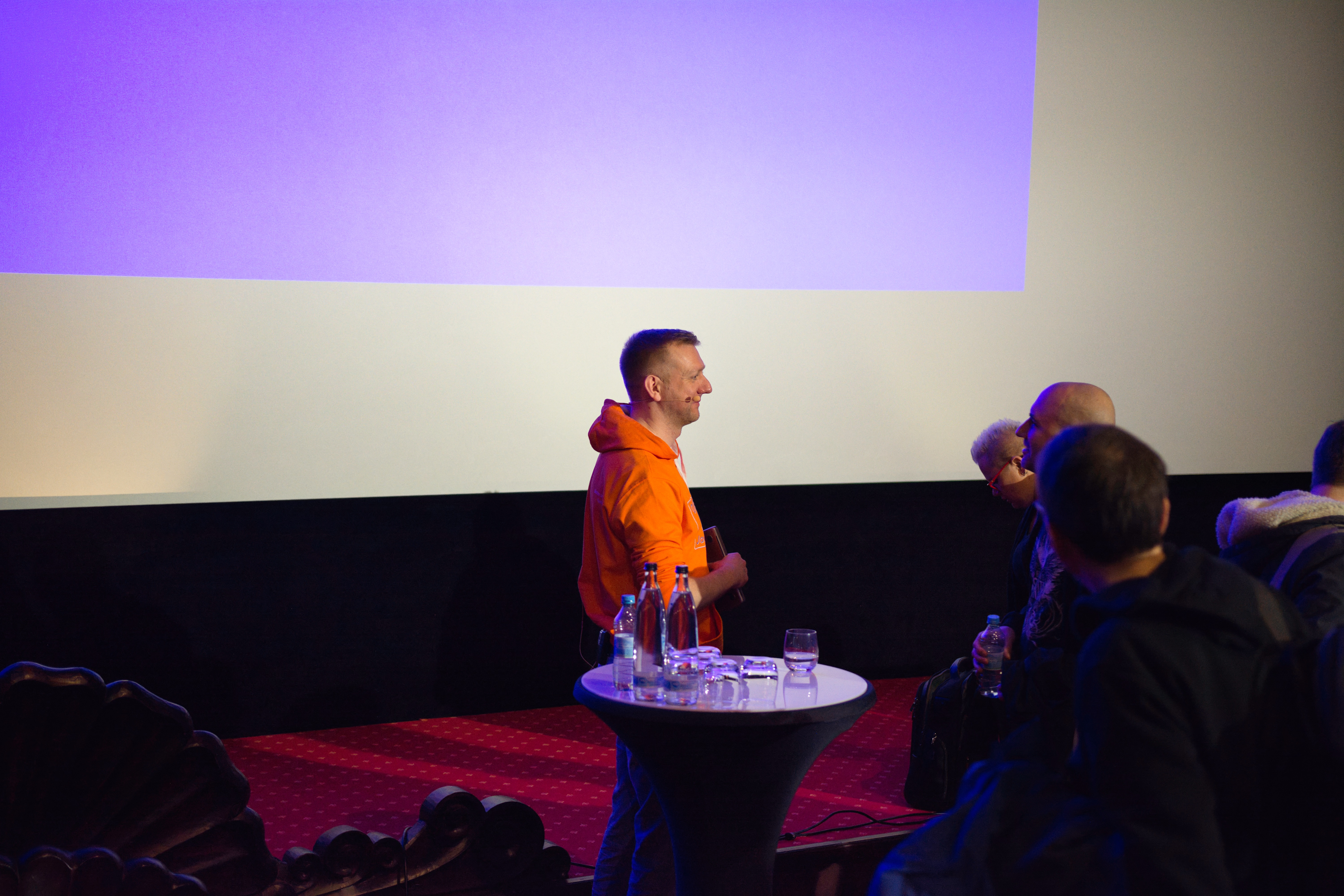
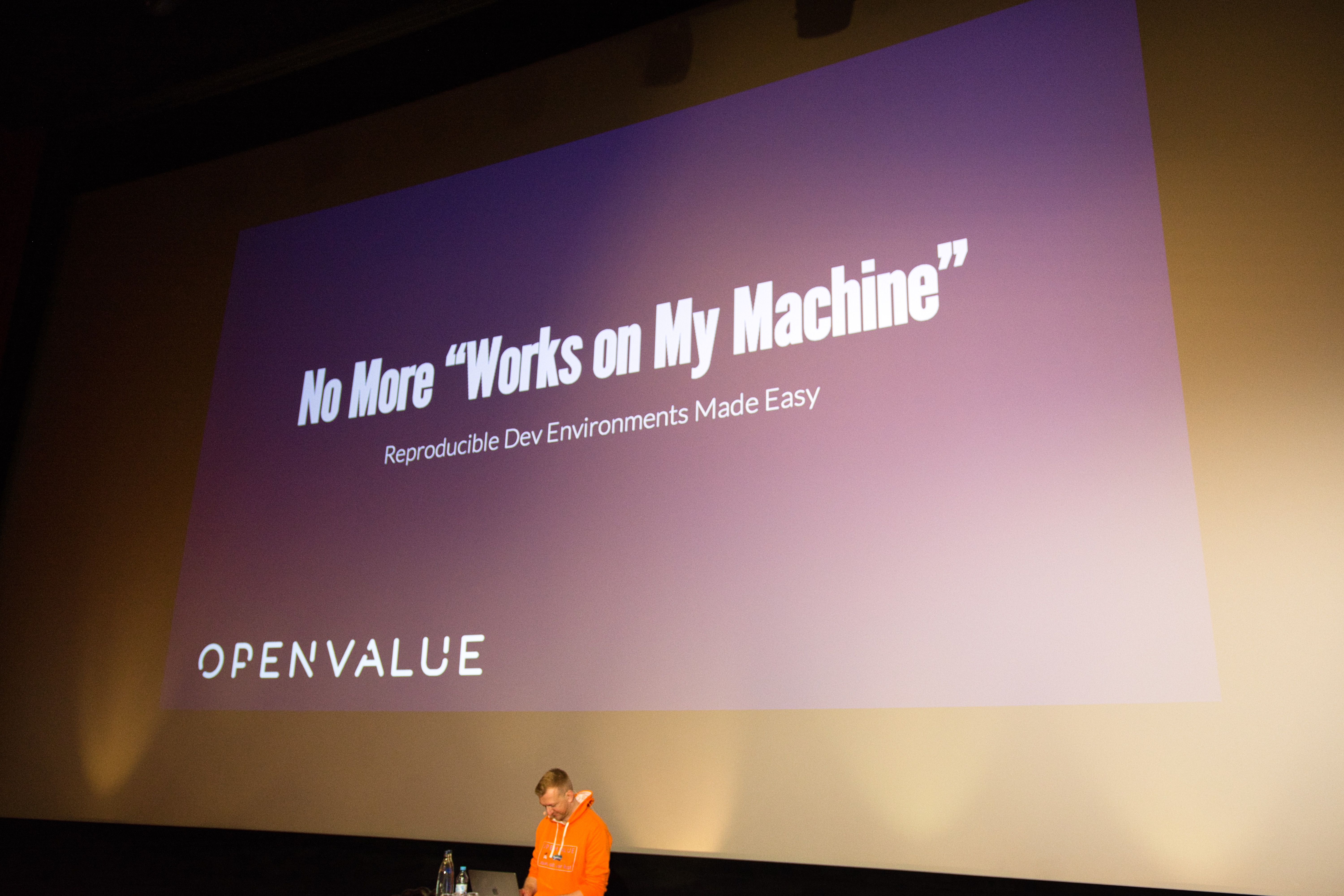
Sascha describes himself as an introvert who pushes himself outside his comfort zone on purpose. Training delivery started at INNOQ, where a colleague’s casual invitation (“I have a training in two weeks, just come along”) accelerated what might otherwise have taken years.
Conference speaking followed, beginning at Socrates, an open-format unconference where someone shared advice that stuck: “The people who are in your conference room chose to be there and are interested to hear your story. That’s your base.”
His favourite conference memory is from JavaLand. A talk about how the JVM behaves inside containers. Niche topic, but a full room. But what made it special was what happened afterward. “Three or four people came up and said: we have exactly these same issues. It’s great to see someone build this up and share it in a way we can understand.”
The thing Sascha is looking for during his talks? People pulling out their phones to photograph slides. “That means they want to show something to their team. That’s when you know the content landed.”
A pragmatic view on AI
On AI in software development, Sascha is pragmatic. “When it started, everyone said developers will become obsolete. I’m always hesitant to jump on that kind of bandwagon, because those predictions mostly have been wrong.”
His approach is to find specific sweet spots rather than applying AI as a blanket solution. Code reviews, brainstorming, repetitive tasks. That’s where he sees clear value. But he’s cautious about wholesale adoption before understanding the trade-offs. What concerns him most about AI is the impact on the next generation of software developers.
“A senior developer is just a junior developer with pain and experience. If AI removes the pain from the learning cycle, where do the future seniors come from?”
He treats AI the way he treats any new tool: understand it, find where it genuinely helps, apply it there, and resist the temptation to solve everything with it at once. “Before AI, it was blockchain. Everyone was looking for a problem to fit the solution. I prefer it the other way around.”
The bottom line
Twenty years in his career, Sascha’s view on it is remarkably consistent: stay curious, share what you know, and never confuse criticism of your code with criticism of your character.
His advice to junior developers? “Try things out. Be open for failure. You’ll fail at the beginning, and that’s fine. But never see feedback on your work as a personal attack. Use it as a learning loop. And share what you learn with others.”
His message to anyone considering OpenValue? “Just do it. You can’t lose. Even if it doesn’t work out, you’ll learn and grow. And the colleagues? They’ll make sure of that.”
Sascha Selzer is a senior Java consultant at OpenValue Düsseldorf, iSAQB trainer, and conference speaker. He speaks at conferences including JCON, JavaLand, and Java Forum about observability, JVM containerisation, and software architecture.
This is the second article in the “Meet the Experts” series. Read the first one: Meet the Expert — Simone de Gijt.
Interested in joining OpenValue? Visit openvalue.eu/career.
Want to level up your skills? Explore the OpenValue training portfolio — by developers, for developers.